Buying reviews · UK
Unistellar Odyssey Pro review: is the eyepiece worth it?
A research-based Odyssey Pro review for shared stargazing: the electronic eyepiece, framing limits, carrying weight and checks before you buy.
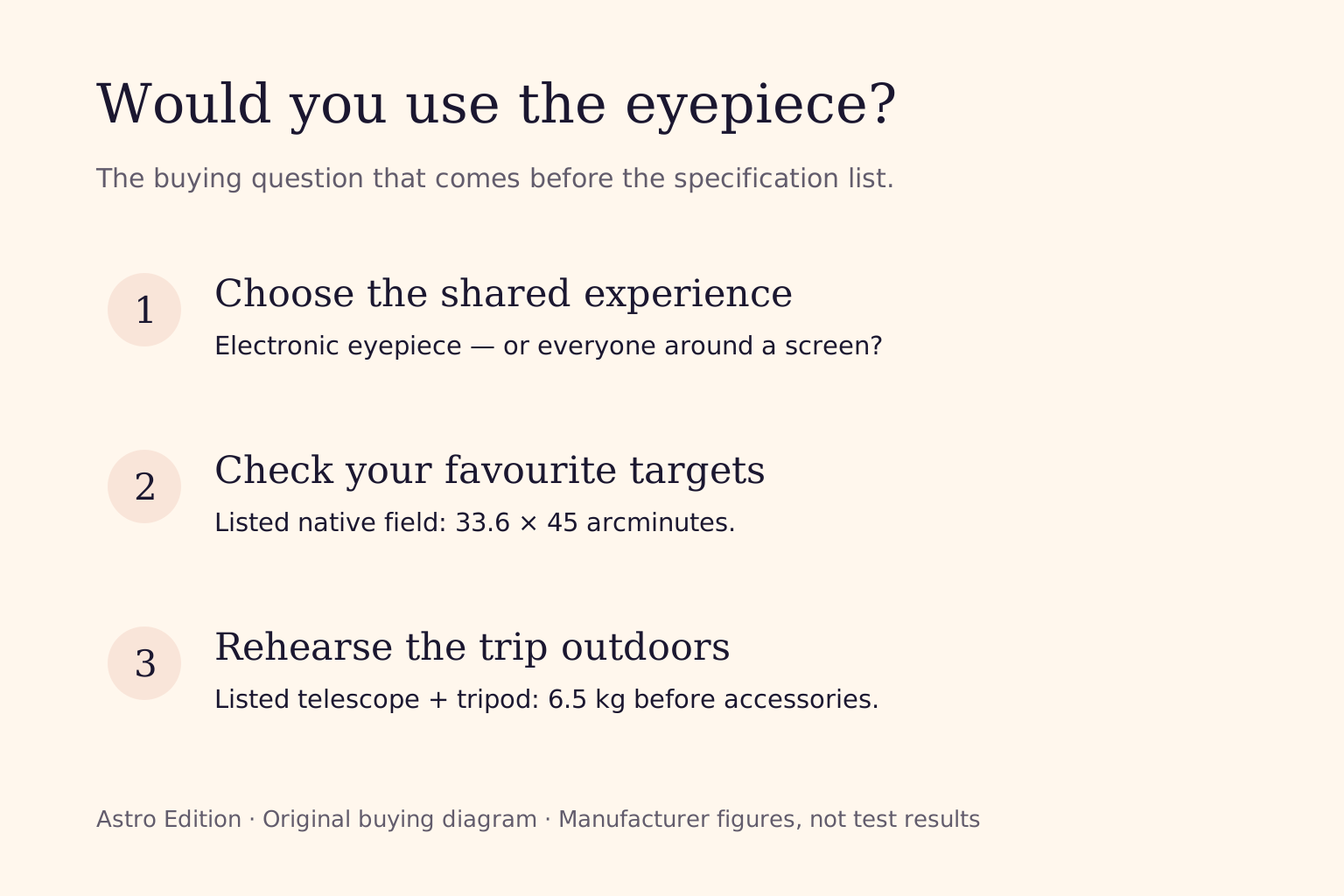
The Unistellar Odyssey Pro makes most sense when taking turns at an eyepiece is a reason you want a telescope. If everyone would rather watch a tablet, start by comparing a screen-led model. Paying for a feature that never becomes part of your evening is a poor shortcut to enjoying astronomy.
This Unistellar Odyssey Pro review is a desk review of manufacturer information, not a field test. We have not measured image quality, connection reliability or battery endurance. Our judgement concerns the buying decision: whether this particular combination of automated observing and an electronic eyepiece fits your plans.
Our verdict: shortlist it for shared eyepiece observing; compare alternatives before buying for app-only imaging. Our three-telescope comparison explains when we would switch away from it.
The eyepiece is the decision, not a bonus
Nikon explains that the Pro uses electronic viewfinder technology in its eyepiece. The regular Odyssey has no eyepiece. Nikon also describes the joint development and Stellar Autofocus.
That distinction matters more than the word “Pro”. The eyepiece displays an electronically produced view; it is not a conventional direct optical view. Decide which experience you want before comparing product names.
Think about the next clear evening you could realistically use it. Would someone choose a target and then invite the others over to look? Or would the household stay together around a screen? Neither is the correct way to enjoy the sky. They are different reasons to spend money.
Our preference for the Pro in an eyepiece-led household is an editorial judgement about that activity. We cannot tell you whether its view will meet your expectations without a demonstration. If possible, arrange one and ask to see the sort of target you actually want to observe.
Frame your favourite targets before ordering
The UK Odyssey Pro listing specifies an 85 mm mirror, 320 mm focal length and a field of 33.6 by 45 arcminutes. Those numbers describe the listed instrument, rather than a result from our own measurements.
For a buying check, the field is about 0.56 by 0.75 degrees, converting arcminutes to degrees by dividing by 60. A hypothetical object one degree across would not fit within that native rectangle. That is a geometric comparison, not a claim about a particular software capture mode.
Make a list of three targets you hope to observe. Check their angular sizes and the manufacturer’s current capture options. If your real interest is broad nebula compositions, compare the wider-field route in our family telescope shortlist. If the target already fits, a larger field is not automatically worth more to you.
Our field-of-view calculator explains framing for other telescope and camera combinations. Do not enter a random camera sensor and treat its result as the Odyssey Pro’s specification: this is an integrated system with its own published field.
Count the whole carry, and the place you will use it
The UK listing gives 4 kg for the telescope and 2.5 kg for its tripod. Together that is 6.5 kg before a bag, phone, charger or other accessories. The same page lists a tripod in the package and quotes five hours of battery autonomy. We have not verified that duration under outdoor conditions.
A useful rehearsal costs nothing: walk from storage to your proposed observing spot carrying an equivalent load safely. Notice doors, stairs, where the tripod would stand and whether the sky is obstructed. This does not test the telescope; it tests whether your intended routine makes sense.
Avoid choosing on the assumption that you will always drive somewhere better. A convenient ordinary observing spot may matter more to actual use than a special trip you rarely make. Our usable imaging-window guide helps you think about the time available, even though the Pro is a different workflow from a modular imaging rig.
What this review cannot settle
Specifications cannot tell us how consistently your phone will connect, how much detail your preferred targets will show from your site, or whether everyone will find the eyepiece comfortable. Manufacturer examples are useful questions to investigate; they are not our test results.
Ask a demonstrator about startup, switching targets, sharing the view and packing away. If you expect to process files later, check the current export workflow and supported formats with the manufacturer. If you want an instrument that can grow through interchangeable equipment, compare a modular route before committing to an integrated product.
Check the offer as a complete package
Compare the delivered total for your country, the included tripod and charging equipment, the seller, support arrangements and return conditions. The UK store and EU store are separate buying destinations. Check the appropriate one rather than assuming a headline offer transfers between countries.
We deliberately leave a live price out of the verdict. A temporary discount should not decide whether an eyepiece is useful to you, and a stale price is no help when you reach checkout.
Our buying decision
Put the Odyssey Pro on your shortlist if you want an automated system and specifically value an electronic eyepiece for shared observing. Pause if your main attraction is a product name, an impressive sample image or a feature you have not yet seen demonstrated.
If the eyepiece is optional in your plans, give the alternatives equal attention. Compare our three picks and check the current regional offers. Those buying links remain ordinary merchant links until an affiliate relationship is verified.
Continue planning
Related guides
Power
Build an astrophotography power budget that survives the night
Optical train
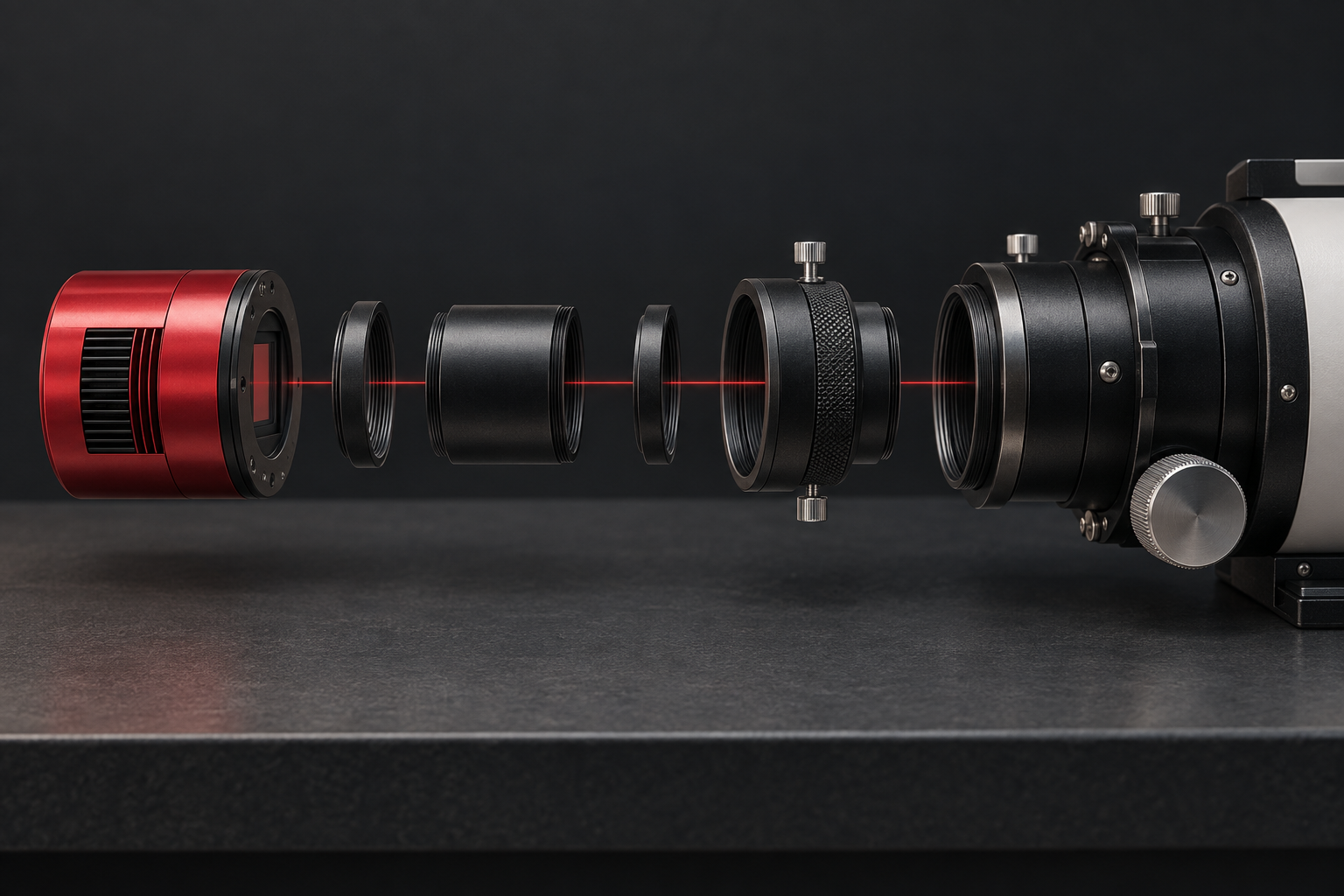
Backfocus and spacing without guesswork
Smart telescope comparison