Optical planning · UK
Choose focal length and field of view before choosing a telescope
Plan an imaging setup around target size, sensor dimensions, image scale and local seeing instead of aperture alone.
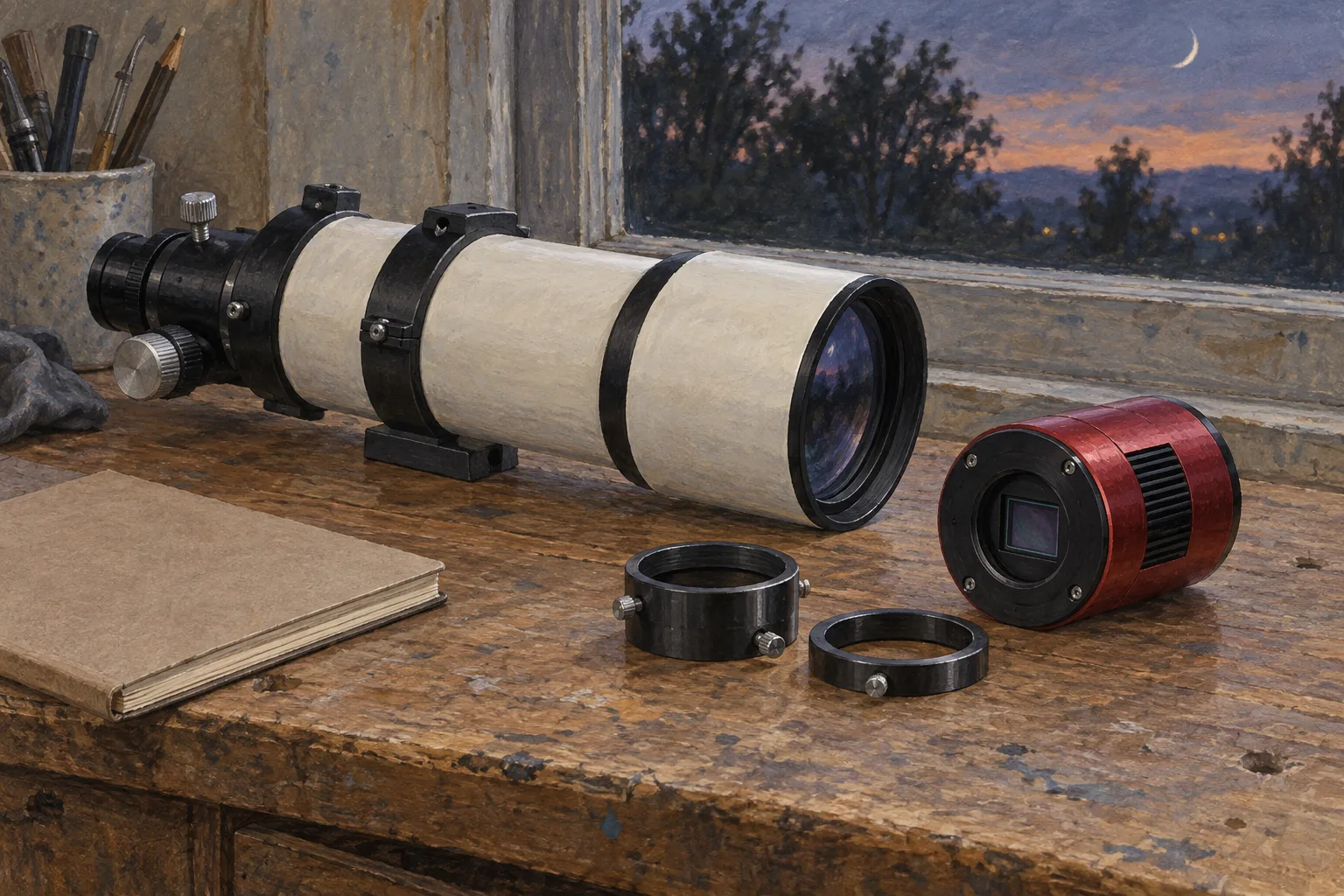
A telescope is only one part of the framing decision. Focal length and sensor size determine how much sky reaches the final image, while pixel size influences the sampling of that image. Start with the targets you want to photograph and work backwards.
Build a target list
Separate wide nebulae and large galaxies from compact galaxies, planetary nebulae and lunar or planetary subjects. A setup that frames a broad emission nebula comfortably may render a small galaxy as a tiny part of the frame. No single focal length is ideal for every target.
Use a field-of-view calculator with the exact telescope focal length and camera sensor dimensions. Check several representative targets rather than relying on one showcase object. Allow space for imperfect pointing, dithering and later cropping.
If you are comparing all-in-one instruments instead, our smart telescope field-of-view comparison explains how native framing, a second camera and mosaics change what fits.
Treat image scale as a system property
Image scale depends on focal length and camera pixel size. Finer sampling can record more detail only when tracking, focus, optics and atmospheric seeing support it. It can also increase guiding demands and reduce tolerance for wind and vibration.
Do not treat a smaller arc-seconds-per-pixel number as an automatic upgrade. In many UK and European locations, typical seeing and variable weather make a moderate, forgiving scale more productive than a theoretically sharper one.
Include reducers and flatteners
A reducer changes focal length and field of view. A flattener may preserve focal length but still adds spacing and connection requirements. Confirm the corrected image circle covers the intended sensor and record the specified working distance.
Check the physical consequences
Longer focal lengths generally magnify tracking error, focus drift and vibration. Larger optical tubes can add wind area and moment arm even when their mass fits the mount’s headline payload. The framing choice therefore feeds back into mount, guiding and enclosure decisions.
Make a simple decision record
Save the target examples, calculated field of view, image scale, sensor diagonal and any reducer factor. If two combinations frame the same targets, prefer the one that leaves more margin in tracking, weight, spacing and budget.
Work through your own plan
Telescope camera field-of-view calculator
Will the target fit the camera frame at this focal length?
Pixel scale and sampling calculator
What does a camera or focal-length change do to image scale?
Telescope eyepiece comparison tool
Do the eyepieces in your shortlist offer useful different views?
Continue planning
Related guides
Power
Build an astrophotography power budget that survives the night
Optical train
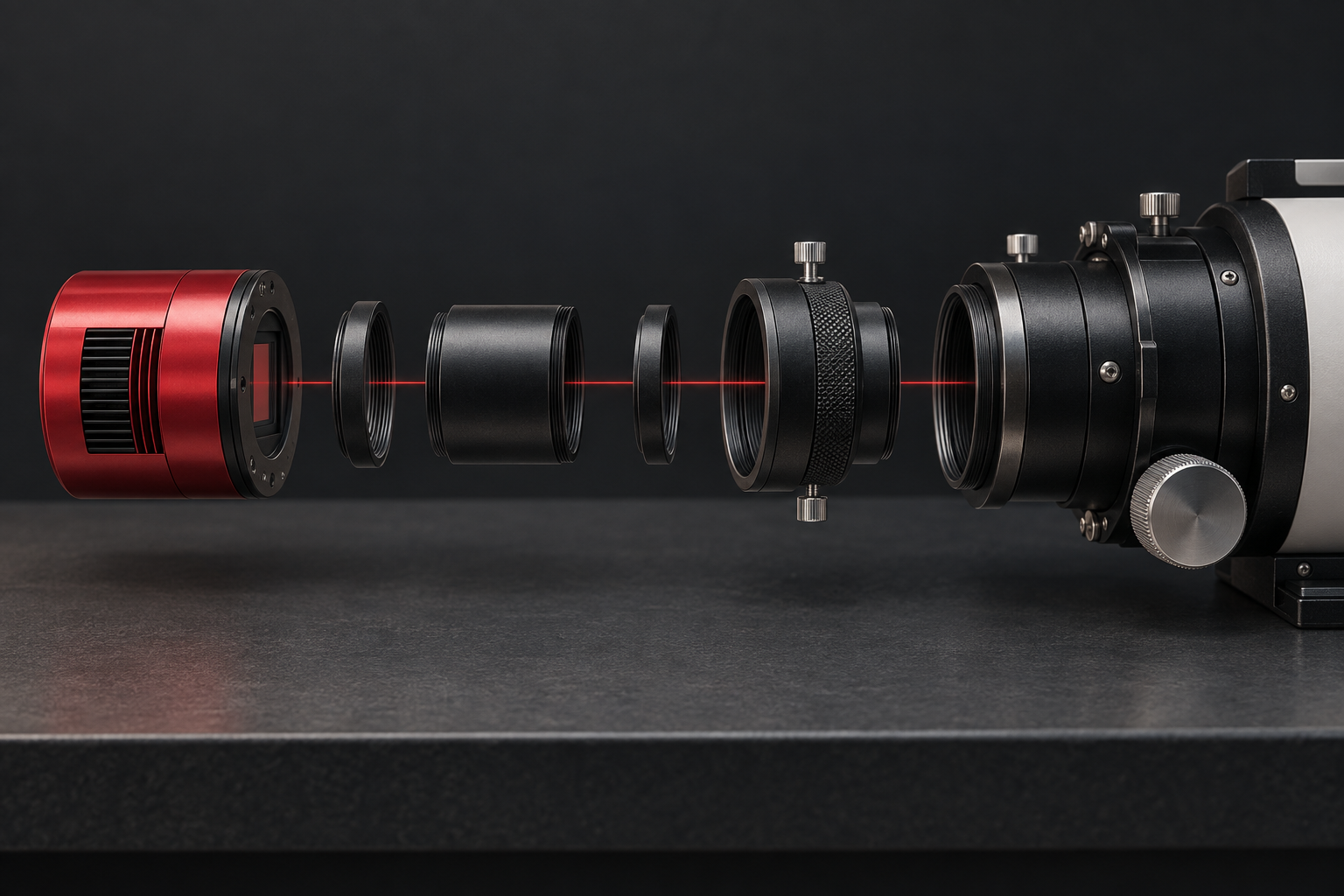
Backfocus and spacing without guesswork
Smart telescope comparison