Mounts · EU
Why mount payload is not the whole answer
How focal length, moment arm, wind, balance and guiding change what an astrophotography mount can realistically carry.
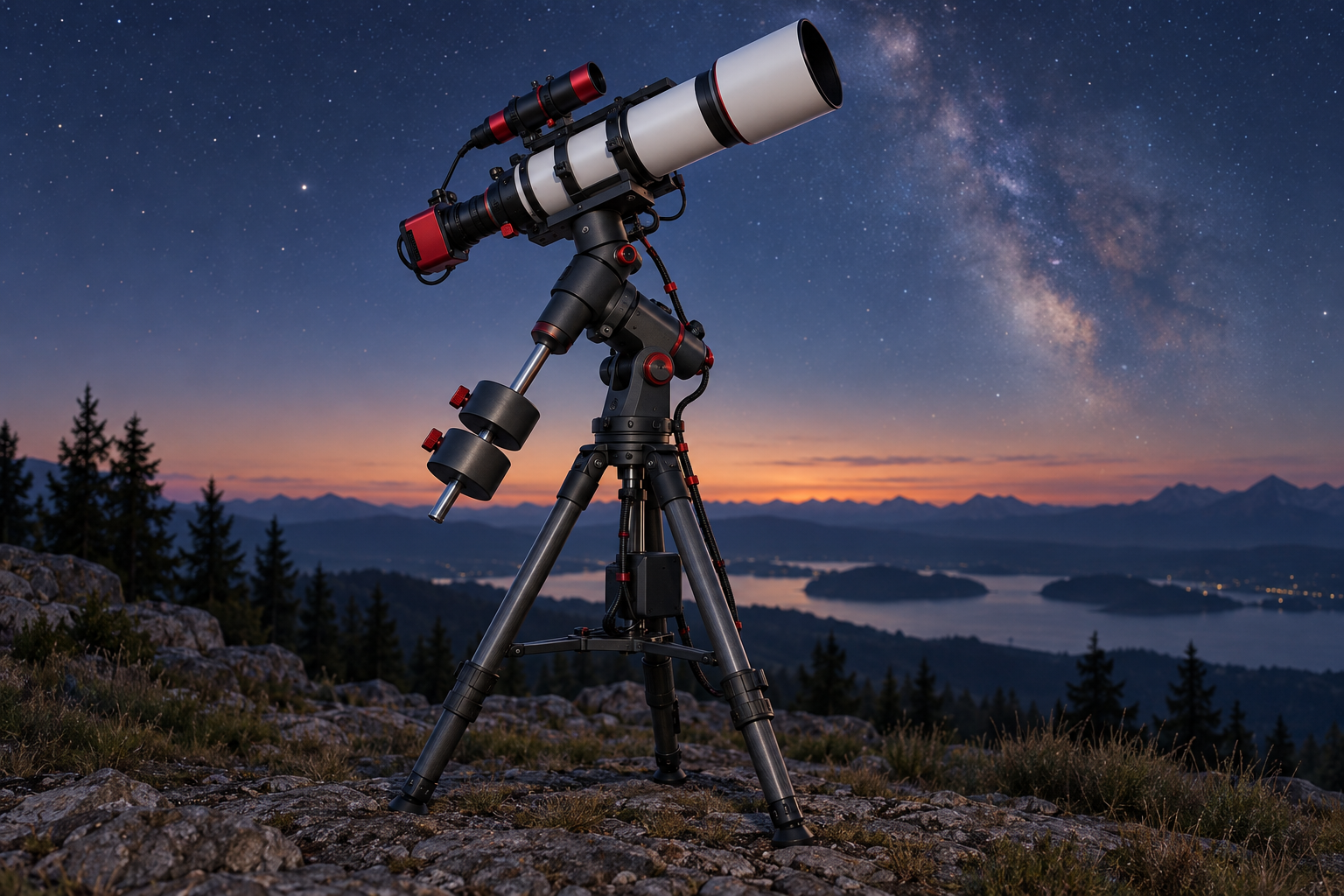
Two imaging rigs with the same total mass can place very different demands on a mount. Payload is useful for screening options, but it is not a complete performance prediction.
Shape changes the load
A long telescope places mass farther from the rotational axes and catches more wind than a compact instrument. Cable drag and accessories mounted away from the centreline add further disturbance.
Resolution changes the tolerance
Longer focal length and smaller image scale make tracking errors more visible. The mount that produces pleasing wide-field stars may not deliver the same result with a longer, higher-resolution optical system.
Use evidence from comparable rigs
When evaluating examples, compare focal length, total equipped mass, telescope shape, exposure duration and local conditions. A success report with a materially different system is inspiration, not proof of compatibility.
Leave room for the real build
Budget for rings, plates, camera, filter equipment, guider, focus hardware, dew control and cables. The optical tube’s published mass is not the imaging payload.
Treat the payload limit as a safety limit, not just a performance figure. A mount that is overloaded, poorly balanced or carrying a long optical tube in wind can bind, tip or drop the equipment, which risks destroying the optics. Stay inside the mounting limit, balance the rig properly and never assume the published limit leaves comfortable headroom on its own.
Work through your own plan
Guide-scope image-scale calculator
What does an entered guiding error mean at the imaging camera?
Continue planning
Related guides
Power
Build an astrophotography power budget that survives the night
Optical train
Backfocus and spacing without guesswork
Smart telescope comparison