Focus measurement and session records · EU
Record focus changes before choosing a temperature trigger
Build a comparable focus record across an imaging night, separate filter changes from temperature observations, and decide what evidence supports a refocus trigger.
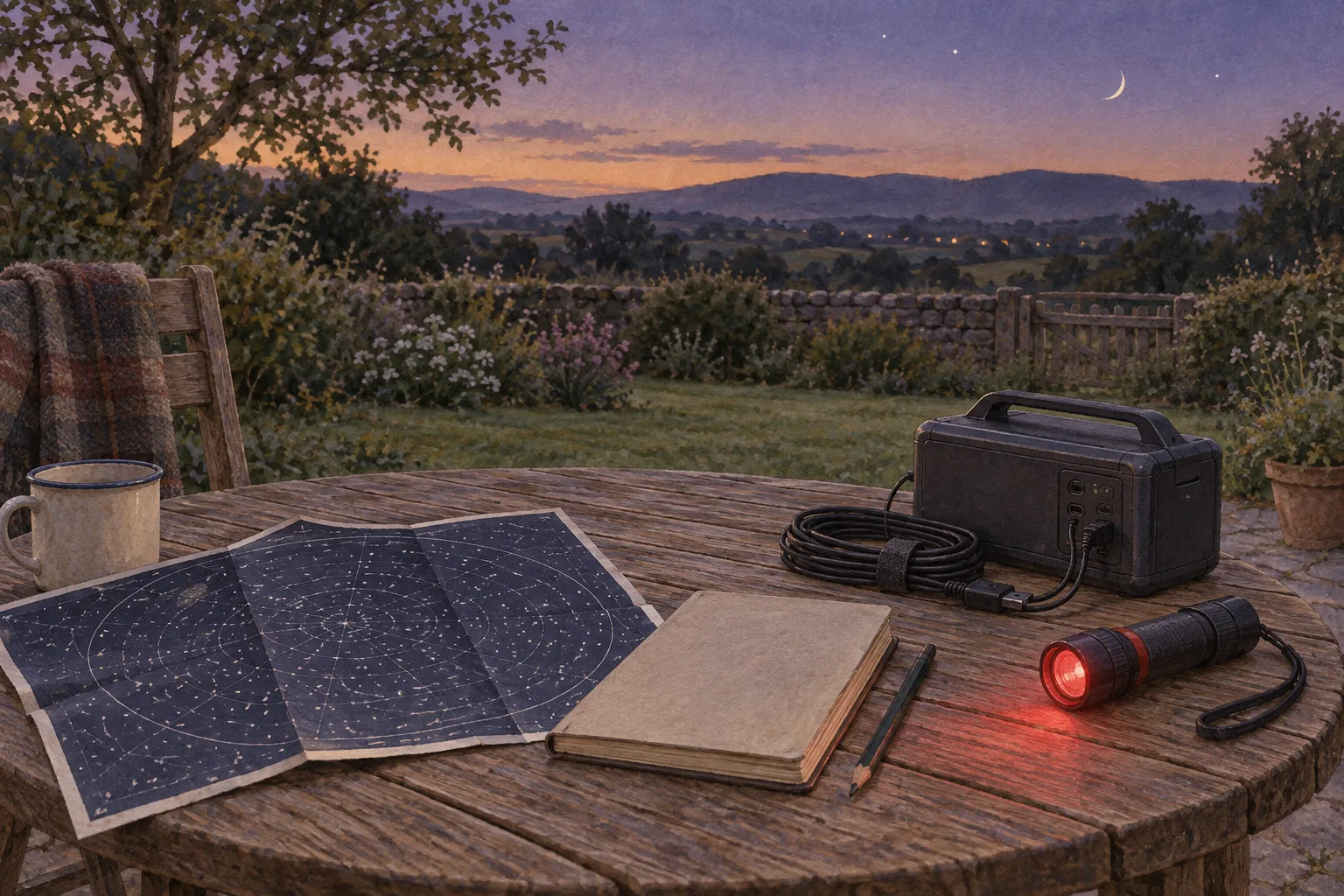
Record successful focus positions alongside temperature, filter and a confirming image before choosing a temperature-based refocus rule. Your first useful result is a record of when refocusing helped. A single night’s change in focuser position does not establish how many steps your telescope needs for every degree of cooling.
N.I.N.A. documents focus movement during a night from temperature changes and other causes, as well as shifts between filters. That makes the circumstances of each measurement essential to interpreting it. N.I.N.A. autofocus documentation
The method below is an editorial recording workflow. It is intended to help you decide whether to keep gathering observations, investigate inconsistent focusing, or trial a refocus trigger under supervision.
Give each focus result enough context
Create one session sheet and identify the telescope, focuser, camera, software version and optical configuration at the top. Record any change to that configuration as a new series. Keep the sheet beside the saved images so that a promising number can always be checked against what the camera captured.
For each focus event, record:
- Time and time zone, target and active imaging filter.
- Filter actually used for focusing, if different.
- Focuser position before and after the run, including the unit reported by the controller.
- Temperature reading and the sensor that supplied it; write “unavailable” when necessary.
- Autofocus success or failure, plus the curve or log filename.
- A saved image immediately before and after, where available.
- Changed settings, visible cloud, wind, a target move or other interruption.
These are proposed fields, rather than a required software format. Their purpose is to stop unlike observations becoming one apparent trend. If you have no numerical focuser position, retain the image and event record, but leave the position field blank. Do not manufacture a step value from an unmarked knob.
Establish a baseline you can revisit
Start with a successful focus run and save a confirming exposure. Keep the filter, exposure settings, binning and analysis method consistent when making your comparison images. If you change one, annotate the boundary rather than silently continuing the same series.
N.I.N.A.’s Star HFR routine measures stars at successive focuser positions and fits a curve to find focus. Its documentation also explains that star detection can struggle with exposures that are too short when stars are far out of focus. A returned position therefore deserves inspection alongside the run’s result and images. How N.I.N.A. measures autofocus
As an editorial check, repeat a baseline run when conditions permit. If successive results look inconsistent, investigate that inconsistency before using their differences to infer temperature behaviour. Keep failed attempts in the record, clearly labelled; exclude them from any list of accepted focus positions.
Keep image measurements in their own column
A focus position describes where the controller moved. A star-size measurement describes an image. Preserve both, with their units and method, rather than treating them as interchangeable evidence.
Siril’s Dynamic PSF analysis provides FWHM and roundness measurements, permits careful manual star selection, and can export the star list as CSV. FWHM can be expressed in pixels or, when image sampling is known, arcseconds. Its explanation also identifies the atmosphere and optical system as contributors to the spreading of starlight. Consequently, a larger FWHM alone cannot identify temperature-driven defocus. Siril image analysis
Choose a repeatable comparison: the same analysis settings and, where practical, the same stars or field region. Record whether a value is FWHM or HFR. Do not combine them into one column labelled “sharpness”. If you need to understand the sampling behind an angular measurement, use the pixel scale calculator and retain its inputs with the session record.
If stars become elongated rather than simply broader, use the repeatable star-shape diagnosis to plan a separate investigation. Avoid changing several mechanical and focusing settings during the same comparison.
Read a hypothetical night conservatively
Consider this explicitly hypothetical record, using invented focuser steps and readings from one identified probe. The configuration and focusing filter remain unchanged:
| Time, UTC | Probe reading | Accepted focus position | Record note |
|---|---|---|---|
| 20:00 | 10 °C | 12,000 steps | Baseline image retained |
| 21:00 | 9 °C | 11,970 steps | Repeat run accepted |
| 22:00 | 8 °C | 11,950 steps | Confirming image retained |
The recorded position falls by 50 steps while the probe reading falls by 2 °C. Dividing those differences gives 25 steps per degree for those endpoints. The intervening changes, however, are 30 and 20 steps. None of these invented observations establishes a reusable compensation coefficient.
The useful next question is whether refocusing improved the comparison images, and whether that result repeats on another night with the same configuration. Keep a filter change or failed run outside this small series. A neat calculation cannot repair a comparison whose conditions changed.
Choose the next action from the evidence
N.I.N.A. offers autofocus triggers after temperature change, filter change and HFR increase. Its temperature trigger requires a focuser temperature probe. The HFR trigger compares a trend against a reference for the active filter; the documentation cautions that consistent autofocus results and suitable seeing matter. N.I.N.A. sequencer triggers
These are reasons to distinguish two decisions. A temperature trigger asks the software to measure focus again after a specified temperature change. A compensation rule would prescribe a position change. Your session sheet may support trialling the former while providing insufficient evidence for the latter.
For the next session, write one concrete decision: gather more comparable runs, resolve unreliable autofocus, or supervise a trial trigger and inspect its confirming images. Preserve the original observations when revising that decision. Include the trial’s focus pauses in your integration-time plan, so your planned imaging time reflects the workflow you actually intend to run.
Continue planning
Related guides
Power
Build an astrophotography power budget that survives the night
Optical train
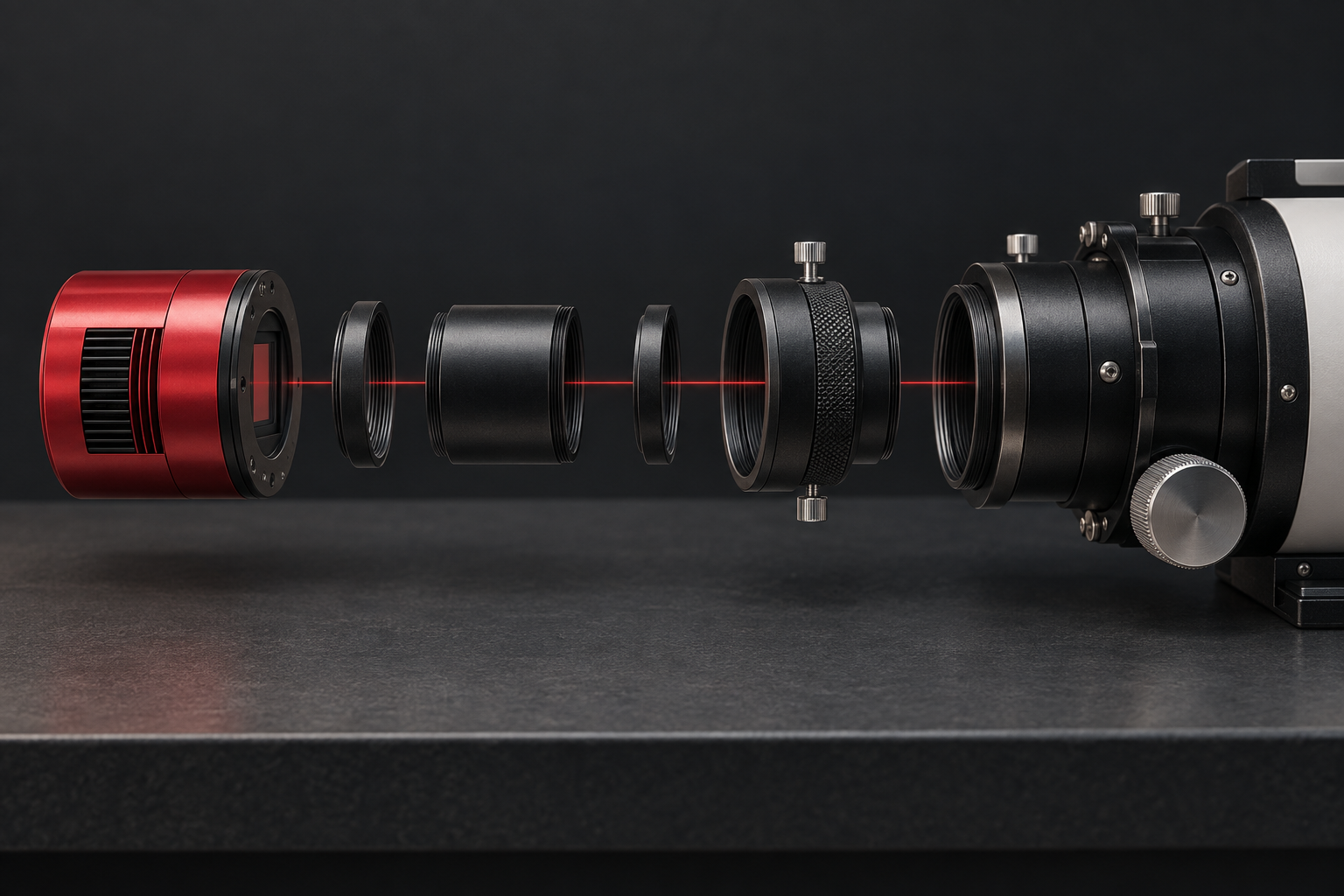
Backfocus and spacing without guesswork
Smart telescope comparison